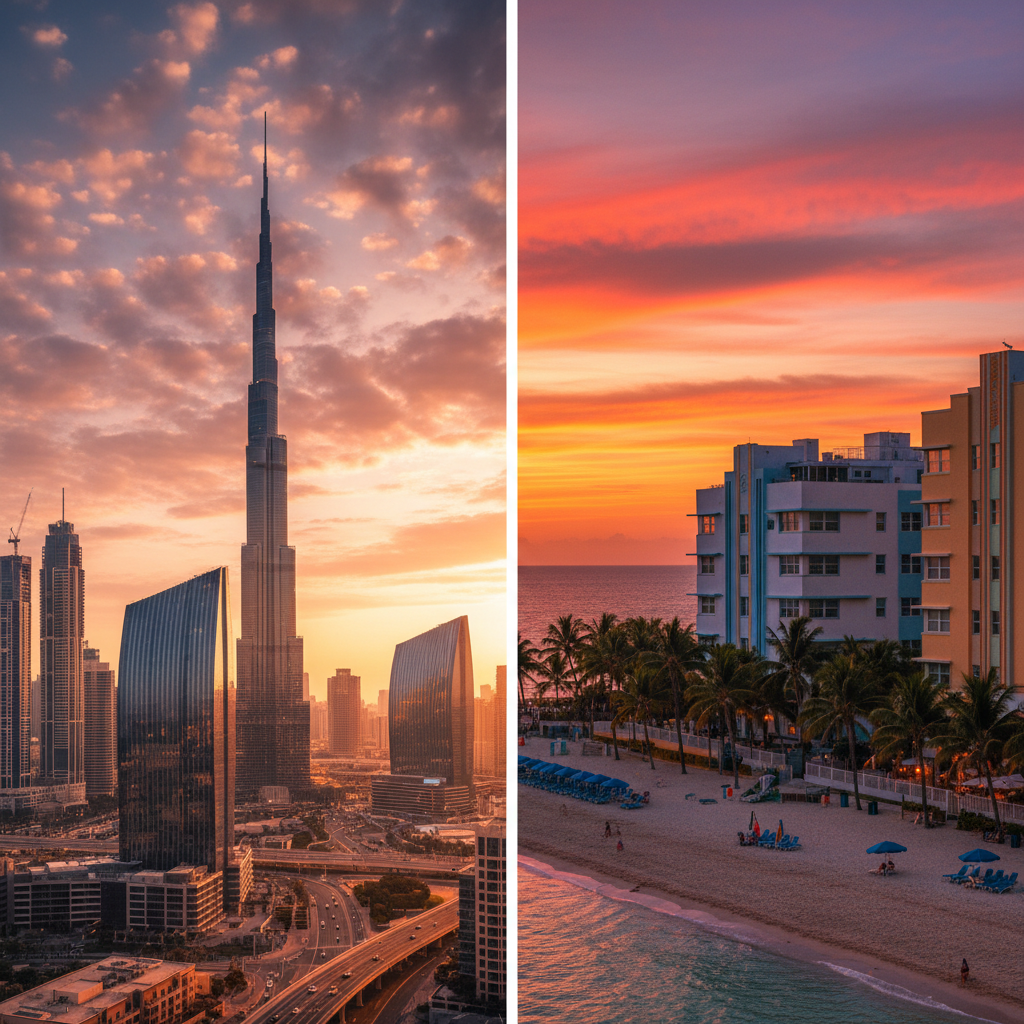
Dubai vs Miami: Where to Invest Your Capital?
20 critical factors — honest analysis for investors choosing between two world-class markets
Miami: The Dream That Costs More Than You Think
Miami has long been the go-to destination for Latin American and European investors looking for a foothold in the US market. Sun, lifestyle, strong demand, international community — the pitch is compelling. And unlike Bali or the Dominican Republic, Miami is a genuinely serious real estate market.
So this comparison is different. We're not dismissing Miami. We're doing what any serious investor should do: running the numbers, reading the fine print, and asking the questions that your real estate agent won't bring up — like what happens to your tax obligations the moment you buy property in the United States.
We compared Dubai and Miami across 20 critical investment criteria. The result is not a landslide — it's an honest score that will help you decide where your capital makes more sense.
DUBAI
0
MIAMI
0
Head-to-Head Comparison
20 critical factors every investor must consider
Taxes on Rental Income & Capital Gains
0% rental income tax. 0% capital gains tax. 0% annual property tax. No reporting obligations for non-residents.
Federal income tax on rental income: 10–37% for non-residents. Capital gains tax: 15–20% federal + Florida has no state income tax (a rare US advantage). FIRPTA withholding: 15% on sale proceeds for foreign sellers.
Verdict: Dubai is one of the few jurisdictions in the world with a complete zero-tax environment for property investors. Miami's tax burden — especially FIRPTA on exit — significantly erodes net returns.
US Tax System Entanglement (FATCA/IRS)
No obligation to register with any tax authority. No forms, no filings, no annual reporting. UAE has no automatic data exchange agreement with most countries.
Buying property in the US creates ITIN obligations, annual IRS filings (Form 1040-NR), FBAR reporting if you have US bank accounts, and FATCA exposure. You are permanently on the IRS radar — even if you never live there.
Verdict: This is the hidden cost most Miami buyers don't discover until after closing. A US property means a permanent administrative and compliance relationship with the IRS. Dubai has no equivalent obligation.
Property Ownership Rights for Foreigners
Full freehold ownership for foreigners in 60+ designated zones. Simple title deed issued by Dubai Land Department. No local partner required.
Foreigners can own property freely. However, certain co-op buildings restrict foreign ownership. Ownership through LLC is often recommended for tax planning, adding legal and accounting costs.
Verdict: Both markets allow full foreign ownership. Miami has more structural complexity (LLC recommended, co-op restrictions). Dubai is simpler and more direct.
Purchase Process: Can You Buy Remotely?
100% remote purchase possible on off-plan projects. Power of Attorney (POA) allows remote secondary market purchases. DLD registration is digital. No physical presence required at any stage.
Remote purchase is technically possible but practically complex. Requires US bank account or wire transfer setup, US attorney, title company, and often in-person notarization or apostilled POA from your country. Closing requires coordination across multiple parties.
Verdict: Dubai is the global benchmark for remote property investment. Miami is manageable but significantly more friction-heavy for international buyers.
Off-Plan Market
One of the world's most developed off-plan ecosystems. Developers offer 0% interest payment plans spanning 3–7 years (including post-handover). DLD escrow protection. Prices typically 15–25% below secondary market at launch.
Off-plan (pre-construction) market exists but is fundamentally different: typically requires 20–50% deposit at signing with no payment plan, no post-handover installments, and no equivalent escrow protection framework. Developer quality varies widely.
Verdict: Dubai's off-plan market is unique globally — you can build a $500K position with $100K down and structured installments over years, with full regulatory protection. Miami's pre-construction requires significantly more capital upfront with less protection.
Exit Strategy: Selling Your Property
Secondary market is liquid. If you are not a UAE resident, selling requires either physical presence or a UAE-notarized/apostilled Power of Attorney (preparable from your home country through UAE embassy). Transaction closes in days once POA is in place.
Resale requires a licensed Florida real estate attorney, title company, and FIRPTA withholding agent. Foreign sellers face automatic 15% withholding on gross sale proceeds (not profit) — refundable only after IRS filing, which takes months. Exit is more bureaucratic and slower.
Verdict: Both markets have friction on exit for non-residents. Miami's FIRPTA withholding is the bigger pain point — your capital is effectively frozen for months until the IRS processes your refund.
Rental Yield (ROI)
Gross rental yield: 6–10% depending on area and asset type. Net yield after all costs: 5–8%. Completely tax-free.
Gross rental yield: 4–6% in prime areas (South Beach, Brickell). Net yield after property tax (1.5–2%), HOA fees — Homeowners Association monthly maintenance fees ($500–2,000+/month), insurance (elevated post-hurricane reform), management fees, income tax: 2–3.5% net.
Verdict: Dubai's net yield is 2–3x higher than Miami's on a post-cost, post-tax basis. Miami's high operating costs are systematically underestimated by first-time buyers.
Property Price Growth (5 Years)
Dubai residential prices: +60–80% average 2020–2025. Prime areas (Palm Jumeirah, Downtown): +100–150%. Off-plan resales: some projects +200%.
Miami residential prices: +50–70% average 2020–2025. Strong performance, driven by domestic migration from high-tax states, Latin American demand, and remote work shift. One of the best-performing US markets.
Verdict: Both markets delivered exceptional 5-year performance. Dubai has an edge in absolute growth and off-plan multipliers, but Miami's growth is also genuinely impressive and backed by structural demographic shifts.
Entry Price Point
From ~$150,000 for a studio in JVC or similar zones. Investor-grade 1-bedroom: $250,000–$400,000. Premium zones (Marina, Downtown): from $400,000. With payment plans, effective capital deployed from ~$50,000–80,000.
Entry-level condos: from ~$300,000–$400,000 in peripheral areas. Brickell/South Beach: $500,000–$1M+. Pre-construction deposits: 20–50% of purchase price. Mortgage available for foreigners but requires 30–40% down.
Verdict: Dubai offers lower absolute entry prices and — critically — fractional capital deployment through payment plans. In Miami you need significantly more capital committed from day one.
Developer Payment Plans (0% Installments)
Market standard: 20–30% down, 0% interest installments over 3–7 years, often including 1–3 years post-handover. Creates exceptional leverage without banking system involvement.
No equivalent. Pre-construction requires large deposits (20–50%) paid in stages during construction. No post-handover installments. If you want financing, it goes through a standard mortgage.
Verdict: This is one of Dubai's most unique structural advantages. The ability to buy $500K of real estate with $100K down and pay the rest over 5 years at 0% interest — guaranteed by DLD escrow — has no equivalent in any major US market.
Mortgage Access for Foreign Investors
Mortgage available for non-residents but less common: 50% LTV maximum, requires income proof, relatively high rates (6–7%). Most foreign investors use developer payment plans instead.
Foreign national mortgages are available from several US and international banks: 30–40% down, rates 7–8%+ (2024–2025 environment). More accessible than Dubai mortgages for qualified borrowers with international credit history.
Verdict: Miami has a more developed mortgage ecosystem for foreign buyers. This is a genuine advantage for investors who prefer leverage through banking rather than developer installments.
Operating Costs (Property Tax, HOA, Insurance)
No annual property tax. Service charge (equivalent to HOA): $2–5 per sq ft/year. No mandatory insurance. Total annual cost: typically 1–2% of property value.
Annual property tax: ~1.5–2% of assessed value. HOA (Homeowners Association — monthly building maintenance & services fee): $500–$2,500+/month in most condos. Homeowner's insurance: significantly elevated post-Hurricane Ian/IDA reform — often $5,000–$15,000+/year for condos. Total annual cost: often 4–6% of property value.
Verdict: Miami's operating cost burden is one of the most underappreciated risks. Insurance costs have exploded post-2022 hurricane legislation, and HOA fees in premium buildings can exceed $25,000/year. These costs directly compress net yield.
Investor Protection & Regulatory Framework
RERA regulates all developers and brokers. DLD escrow accounts protect off-plan buyers (funds released only by construction milestone). Dispute resolution through RERA Rental Dispute Centre. All transactions digitally registered.
Florida has developer disclosure requirements and escrow rules for pre-construction deposits. However, several high-profile condo projects have faced delivery delays, lawsuits, and financial difficulties with limited recourse for buyers.
Verdict: Dubai's RERA/DLD framework is more rigorous for off-plan protection specifically. For secondary market transactions, both markets offer reasonable protection. Dubai wins on pre-construction buyer security.
Golden Visa / Residency by Investment
2-year investor visa with property from ~$180,000. 10-year Golden Visa with property from ~$545,000 (AED 2M). Family included. No minimum stay requirement. Tax residency status available.
No direct residency through property purchase. EB-5 visa: minimum $800,000–$1,050,000 investment in a new commercial enterprise (not just property). Process takes 3–7+ years. Property purchase alone gives no US immigration benefit.
Verdict: Dubai's residency path is one of the most accessible investor visa programs globally. The US offers no equivalent property-purchase-to-residency pathway. The EB-5 is a fundamentally different instrument — complex, expensive, and slow.
Capital Movement & Banking Freedom
No capital controls. Free movement in/out of UAE. Multi-currency accounts. No automatic exchange of financial data for non-residents (UAE is outside CRS for residents). Crypto-friendly jurisdiction.
All US transactions subject to FinCEN reporting above $10,000. Bank accounts for non-residents require extensive documentation. FBAR: annual report required if US bank balances exceed $10,000 at any point. Wire transfers monitored by OFAC/BSA.
Verdict: Once you have a US bank account or property, your financial activity is visible to US regulators and subject to reporting requirements. Dubai provides maximum financial privacy within legal AML compliance.
Safety & Security
Consistently ranked top 3 globally in personal safety. Zero tolerance for crime. Police response time under 3 minutes in most areas. No gun violence. Ranked #1 safest city by Numbeo 2024.
Major US city with real crime considerations: property crime, car break-ins, and gun violence are statistically significant. Ranked among mid-tier US cities for safety. Tourist areas (South Beach, Brickell) are generally safe but not comparable to Dubai.
Verdict: The safety gap between Dubai and Miami is large and real. This matters to investors not just personally — it affects rental demand quality, tenant profile, and property management complexity.
Political & Legal Stability
Stable, long-term governance with clear 20-year development vision (Dubai 2040). Property laws for foreigners have been consistently strengthened. No risk of political reversal on investor rights.
Democratic political system with stable rule of law. However: Florida real estate regulations are subject to legislative change (HOA reform 2023–2024 is a current example), and federal tax policy can shift with administrations.
Verdict: Dubai offers exceptional policy consistency for real estate investors. Miami operates within a strong legal system but is subject to more political and regulatory variability, especially at the state and federal level.
Rental Market & Tourism Demand
Year-round demand: business tourism Oct–May, leisure tourism year-round, large permanent expat community (92% of population are foreigners). Short-term rental licensing (DTCM permit) is accessible. Vacancy rates below 5% in prime areas.
Strong seasonal demand: peak Dec–Apr. Latin American and domestic US tourist base. Short-term rental regulations vary by municipality and building — many Miami condos prohibit Airbnb. Long-term demand from financial services and tech sector (Brickell).
Verdict: Dubai's year-round demand profile and accessible short-term rental licensing make it more consistent for income generation. Miami's Airbnb restrictions in premium buildings are a significant constraint.
Quality of Life & Infrastructure
World-class infrastructure: Metro, highways, airports. Modern urban planning. Healthcare and education comparable to top European cities. Safety and cleanliness standards consistently top-ranked. Tax-free salaries attract elite professionals.
Excellent lifestyle city. Strong dining, nightlife, cultural scene, beaches. Infrastructure challenges: traffic congestion, flooding risk (sea level rise), older building stock (Surfside collapse highlighted structural risks). Healthcare quality high.
Verdict: Both are genuinely excellent lifestyle cities. Dubai wins on infrastructure modernity and safety. Miami wins on cultural depth, nightlife, and proximity to Latin America. Quality of life is genuinely competitive.
Long-Term Market Outlook (5–10 Years)
Population growth program targeting 5.8M by 2040 (from ~3.5M today). 100+ new residential projects annually. Expo City, Dubai South, Dubai Islands — multiple growth corridors. Government actively removes barriers to investment.
Structural tailwinds: Sun Belt migration, financial services relocation from NYC, Latin American capital flight, climate refugees from high-tax northern states. Risk factors: sea level rise and insurance costs are long-term structural threats. Supply pipeline growing.
Verdict: Both markets have strong long-term fundamentals. Dubai's government-driven growth mandate and zero-tax environment give it an edge in attracting international capital. Miami's sea-level risk is a genuine long-term concern that is increasingly priced into insurance costs.
Final Score
DUBAI
19
MIAMI
4
Dubai wins on tax efficiency, off-plan value, operational simplicity, safety and residency — Miami wins on mortgage access, with shared points on ownership rights, price growth and lifestyle
What Miami Buyers Often Discover Too Late
The costs that don't appear in the brochure
Miami is a legitimate, serious real estate market. But the gap between the headline yield and the actual net return — after taxes, FIRPTA, insurance, HOA, and IRS compliance costs — is wider than most international buyers expect. Dubai's total cost of ownership is fundamentally simpler and cheaper.
Lifestyle: An Honest Side-by-Side
Both cities genuinely deliver world-class lifestyle. The choice often comes down to which international community you want to be part of.
| Aspect | DUBAI | MIAMI |
|---|---|---|
| Beach & Climate | ✓ Year-round sun, pristine beaches | ✓ Year-round warm, strong beach culture |
| International Community | ✓ 200+ nationalities, global hub | ✓ Strong Latin American & US expat mix |
| Dining & Nightlife | ✓ World-class restaurants, safe nightlife | ✓ Iconic dining & nightlife scene |
| Cultural Heritage | ~ Developing arts/culture scene | ✓ Art Basel, rich Latin cultural scene |
| Business Environment | ✓ 0% tax, free zones, easy setup | ~ US taxes but strong financial ecosystem |
| Safety | ✓ #1 safest globally | ~ Mid-tier US city safety |
| Healthcare | ✓ Premium private healthcare | ✓ Excellent hospitals |
| Education | ✓ 200+ international schools | ✓ Good private & university options |
Our Honest Investment Recommendation
Miami is real. It's not Bali or the Dominican Republic. But when you run the full numbers — taxes in, taxes out, operating costs, compliance obligations — Dubai consistently comes out ahead for the international investor.
Choose Dubai If:
- You want 0% tax on income and capital gains
- You prefer a payment plan over a large upfront commitment
- You want residency benefits from your investment
- You need maximum capital efficiency and operational simplicity
- You want to buy and manage 100% remotely
Miami Makes Sense If:
- You want USD-denominated assets in a US legal jurisdiction
- You already have US tax exposure and a CPA relationship
- You qualify for a foreign national mortgage and want leverage
- You or your family plan to spend significant time there
- Latin American capital preservation in the US system is a priority
For pure investment return, Dubai wins. For US legal protection and dollar exposure, Miami has its logic. Ideally — consider both.

Oleg Malkin
Professional Investor & Wealth Management Advisor
RERA Broker Card #91322
Russian, Ukrainian, English, German
Expert in investment strategies, portfolio diversification, and risk management across international markets. Helps investors compare Dubai vs other global destinations with real data.