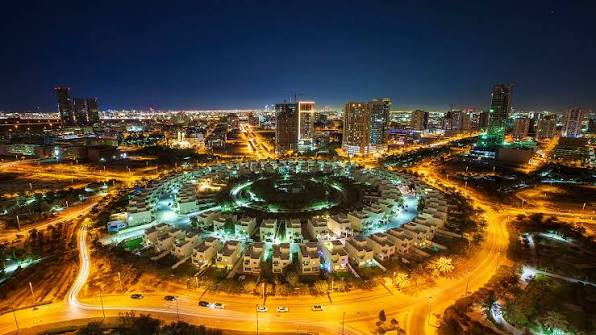
JVC: Dubai's Residential Melting Pot — and Why Universal Demand Can Be a Defensive Investment Strategy
In uncertain markets, the safest location is often the one that does not need a single reason to work
Real estate investors often look for a catalyst.
A new business district. A university. A transport project. A major employer. A tourist destination. All of these can create demand.
But in periods of uncertainty, there is another type of location that can be even more valuable: a district that does not depend on any single catalyst at all.
In Dubai, one of the clearest examples is Jumeirah Village Circle — JVC. JVC is not Dubai's most glamorous residential address. That may be precisely why it has become one of its most universal.
Why JVC Is Different: Five Structural Pillars
Universal Tenant Base
Young professionals, couples, families, remote workers, cabin crew, commuters to Marina/Downtown — JVC does not need one type of tenant.
Multi-Directional Connectivity
3 major road corridors: SMBZ Road, Al Khail Road, Hessa Street. Dubai Marina ~18 min, Palm ~15 min, Downtown ~22 min. Viable from dozens of employment hubs.
Mature Community Infrastructure
Parks, schools, nurseries, Circle Mall, healthcare, supermarkets, mosques. 95,000+ residents by 2021. Services already exist — not a future promise.
Metro Gold Line (2032)
AED 34B, 42km, 18 stations. JVC confirmed as a strategic stop. Connects Al Ghubaiba → Business Bay → MBR City → JVC → Jumeirah Golf Estates.
A District Approaching Completion
Most remaining off-plan pipeline delivers by 2028–2029. JVC is in its final construction phase — investors and tenants gain a community without construction noise across the road.
1. Dubai's Residential Melting Pot
New York has historically been described as a great melting pot: a place where people from very different backgrounds arrive, mix and begin new chapters of their lives.
On a much smaller scale, JVC performs an interesting version of that role within Dubai's residential market. For many newcomers, particularly within the broad middle-income professional segment, JVC can function as a landing zone.
JVC has enough variety of housing that a resident does not need to leave the community as their life changes — from studio to one-bedroom, to two-bedroom, to townhouse or villa. This internal residential ladder matters.
2. Location Without a Single Destination
The geographical advantage of JVC is sometimes misunderstood. It is not that JVC is closest to one particular employment centre. It is that it is reasonably close to many of them.
Nakheel describes the 560-hectare community as having direct access through three of Dubai's critical road corridors: Sheikh Mohammed Bin Zayed Road · Al Khail Road · Hessa Street.
Employment hubs within reasonable commute
The point is not that every journey takes exactly 20 minutes. Dubai traffic makes any such promise unrealistic. The point is that there are many viable journeys. That dramatically widens the pool of people for whom JVC makes sense.
3. Close to the Beach — Without Paying to Live on It
Dubai Marina and JBR are globally recognisable locations, but many residents simply do not need to pay Marina or beachfront residential costs in order to enjoy the coast.
From JVC, JBR is roughly 15 kilometres by road, with off-peak driving estimates around 15 minutes; other parts of Jumeirah Beach are generally within roughly the 15–20 minute range.
This creates a particularly attractive proposition for people who like proximity to the coast but do not organise their entire life around living directly beside it. The beach remains accessible. The Marina remains accessible. Palm Jumeirah remains accessible. But the resident can live in a newer apartment, often with more amenities and at a more manageable housing cost.
The price gap is not marginal. Based on DLD transaction data for the first half of 2026, here is how the three locations compare on average price per square foot:
Dubai Marina trades at roughly a 36% premium per square foot over JVC. JBR — the beachfront itself — trades at roughly a 50% premium. The JVC resident is approximately 15 minutes from the same coastline, without paying for it in every square foot of the purchase price.
On a typical 800 sq ft one-bedroom apartment, that translates to roughly AED 1.21M in JVC versus approximately AED 1.65M in Dubai Marina and AED 1.81M at JBR — a saving of AED 440,000–600,000 for a 15-minute drive to the same beach.
The beaches immediately north of JBR — Um Suqeim and the Jumeirah public beaches — are geographically even closer to JVC, but the residential land there is overwhelmingly not available for freehold purchase by non-nationals. JBR and Dubai Marina remain the most accessible waterfront communities where an international buyer can actually acquire property — and they are the correct comparison point for this analysis.
4. Positioned Between Dubai's Two Airports
JVC sits unusually well within Dubai's changing aviation geography. Dubai International Airport — DXB remains the city's dominant international gateway. At the same time, Dubai is developing Al Maktoum International Airport — DWC into the city's future aviation megahub.
JVC lies between the two broader airport corridors rather than being positioned at an extreme end of the city. DWC is roughly 24 kilometres away, around 20–25 minutes in favourable traffic. DXB is approximately 30 kilometres away, generally around 30 minutes depending on traffic.
5. A Mature Community — Not a Promise
JVC is no longer an experiment. Nakheel began developing the community approximately two decades ago. By 2021, the master developer was already reporting a residential population of around 95,000 people. Since then, substantial additional residential stock has been completed.
JVC contains parks, sports facilities, schools and nurseries, mosques, restaurants, supermarkets, healthcare services and Circle Mall. Nakheel describes the community explicitly as a family-oriented neighbourhood with schools and amenities distributed throughout its green areas.
Residents are not buying into a future promise that one day there will be shops, parks, schools and services. They already exist.
6. The Gold Line Changes the Remaining Weakness
Historically, perhaps the most obvious weakness in the JVC proposition has been the lack of direct Metro access. That is now scheduled to change.
In April 2026, Sheikh Mohammed bin Rashid Al Maktoum approved the new Dubai Metro Gold Line, a AED 34 billion, 42-kilometre underground route with 18 stations.
The official Dubai Government announcement specifically identifies Jumeirah Village Circle as one of the strategic areas through which the Gold Line will pass. The route will run from Al Ghubaiba through central Dubai, Business Bay, Mohammed Bin Rashid City, Meydan, Al Barsha South and JVC before terminating at Jumeirah Golf Estates.
The Gold Line will connect with the Red Line at Business Bay and Jumeirah Golf Estates, with the Green Line at Al Ghubaiba, and with Etihad Rail at Meydan and Jumeirah Golf Estates. Completion scheduled: 9 September 2032.
The government has confirmed that the Gold Line passes through JVC. The exact final station locations within the community have not yet been publicly detailed station by station. Be suspicious of any project claiming a precise five-minute walk to a particular future Gold Line entrance without supporting official documentation.
7. JVC Is Approaching Its Final Form — and That Is an Advantage
One of the most overlooked aspects of JVC today is not what it lacks — but what it is about to finish becoming.
The sheer volume of construction currently visible inside JVC can make the district feel less mature than it really is. But there is a critical difference between building a new community and adding new buildings to an established community. JVC is overwhelmingly the latter.
The basic road system, parks, retail ecosystem, schools and residential identity already exist. Over the next several years — with the bulk of the current pipeline expected to hand over by 2028–2029 — much of today's construction will transition into occupied buildings.
What this means in practice is significant for both residents and investors.
For residents
For a resident, buying or renting in JVC today — or taking delivery of an off-plan unit in 2027–2029 — means entering a community that is essentially complete. Not a site surrounded by cranes and concrete barriers. A neighbourhood with roads, parks, retail, schools and neighbours already in place.
For investors
For an investor, this changes the product being offered to the rental market. A tenant today may weigh JVC against other options and discount slightly for active construction. A tenant in 2029 will increasingly be choosing between buildings in a finished neighbourhood.
Compare this to emerging districts where the first decade of occupancy means living through the construction of an entire surrounding community. JVC skips that phase entirely for anyone entering after 2027.
Most of the remaining off-plan pipeline in JVC is expected to deliver between 2026 and 2029. After that, new construction parcels inside the community are limited — JVC's master plan is largely allocated. What remains will be refinement, not reinvention.
8. The Supply Paradox: Enormous Volume, Enormous Liquidity
No serious investment discussion about JVC can ignore supply. According to current DXBinteract data, approximately 47,455 off-plan units sit within the future pipeline across around 100 active off-plan projects. That is enormous.
""JVC always rents, therefore anything in JVC is a good investment." It is not. As more apartments are delivered, competition between buildings becomes more intense."
In other words, JVC combines enormous supply with enormous market activity. That is precisely what makes it interesting.
9. Liquidity Itself Becomes an Amenity
Most property analysis treats liquidity as something relevant only when an owner wants to sell. That is too narrow.
In JVC, a tenant can search dozens of buildings. A family can compare layouts. Someone dissatisfied with one landlord can move to another building without changing school, supermarket, commute or neighbourhood. A newcomer can rent temporarily while learning the city.
An investor has a large pool of brokers familiar with the location. Banks understand the market. Property managers understand it. Residents recognise the name. This creates an ecosystem around the real estate itself.
10. What Happens If Dubai's Growth Slows?
Most investment cases are written around growth. But a defensive strategy should also ask the opposite question: what happens if growth disappoints?
When demand becomes scarcer, something important often happens: demand becomes more selective. During a boom, people tolerate construction sites, missing retail and emerging locations with uncertain futures. When conditions become more cautious, people tend to prefer what they understand.
The same building might accommodate:
The Defensive Investment Is Not JVC — It Is the Right Property Inside JVC
A strong location cannot rescue every poor asset. In a community with significant future supply, investment selection becomes even more important.
JVC Is Not a Bet on Dubai's Next Big Thing
And that may be its greatest strength.
For a long-term investor, that may be one of the most valuable forms of protection real estate can offer: not certainty about the future, but many different reasons for somebody to keep wanting your apartment.
Key Numbers
Final Completion Thesis
JVC is simply useful to a very large number of people. That is why it can be viewed as Dubai's residential melting pot — and potentially one of its more defensive residential markets. Not because demand can never fall. Not because prices can never correct. But because if the overall pool of residential demand becomes smaller, JVC has a credible chance of capturing a disproportionate share of what remains.
JVC on the Map
This article is for informational purposes only and does not constitute investment advice. All data cited from publicly available sources (DXBinteract, Nakheel, Dubai Government). Past performance is not a guarantee of future results. Consult qualified advisors before making investment decisions.